Celebrating National Native American Heritage Month
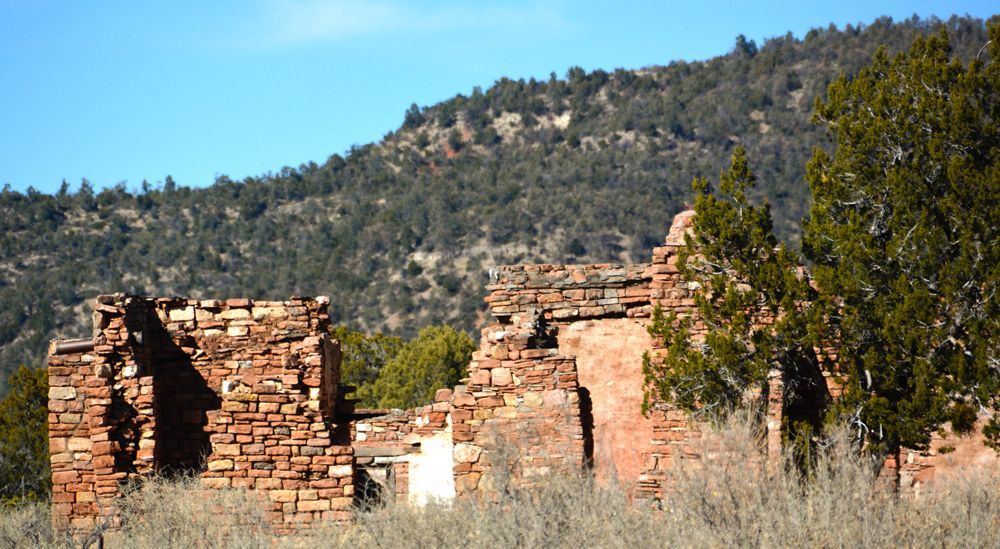
Kinishba is the only historical site on the Fort Apache Indian Reservation that allows entry to non-tribal members. Admission fees and registration must be paid at the Fort Apache Historical Park’s Culture Center, located in Fort Apache just south of Whiteriver.
Upon paying admission, you’ll receive a visitor’s guide to Kinishba. The Visitor’s Guide to Kinishba includes information corresponding to the numbered posts you encounter along the main path. Each numbered post includes information about the part of the ruins you are observing and historical facts about the location. Encircling the rebuilt ruins, the path borders a deep ravine and crosses to the caretaker’s quarters.
The dirt and gravel path that guides you through the site is about a third of a mile long and fairly easy to walk. However, the path near the ravine on the east side of the ruins slopes slightly but evens out as the path leads towards the caretaker’s quarters. A cobblestone path leads around the caretaker’s quarters before becoming dirt and gravel near the guesthouse.
The ruins themselves are a sight to see, even right from the V-gate that separates the site and gravel parking lot. After miles of paved roads and communities that surround the highway leading to the Culture Center and Kinishba, it’s a wonder to see ancient ruins only miles from modern conveniences.
The mountains surrounding the valley with the ruins cut the endless fields from the sky, and they gradate from a deep blue in the visible ridges of the hills to a sage green where individual juniper trees are visible. Sunflowers and cacti line the path leading to the National Register Monument, which leads to the first numbered post - one of ten - detailing the history and size of Kinishba in its heyday.
Once home to the ancestors of today’s Zuni and Hopi Pueblo tribes, the ruins remain a reminder of days long past - though the lifestyle of the people who inhabit the area slightly echoes that of the previous inhabitants. The area remains a land fruitful to its native people, with local agriculture fields and livestock pens in the same valley where people have lived and thrived since approximately AD 800. Facts and historical information are given in the Visitor’s Guide and can be further researched in books available at the Culture Center. The experience is one not to be missed or forgotten, and paired with the trail guide and artifacts at the Culture Center, makes for a memorable day celebrating Native American Heritage Month.
NOTE: “Known in Hopi oral traditions as Mäi’povi (Place of Abundant Snakeweed) and to Apaches as kį dałbaa (brown house), Kinishba Ruins is the sprawling remains of a plaza-focused village where people lived from about A.D. 1200 into the 1400s. Located just west of Fort Apache and Whiteriver, on White Mountain Apache tribal land, the site sits in a grassy, conifer-fringed valley that drains into the White River, a principal tributary of the Salt River. ... local Apache workers excavated about 240 of Kinishba’s approximately 600 rooms. “
— Archeology Southwest Magazine
Portions of this article written by Sheena Hendricks