The Coyote fir by Green's Peak
Photos and text by Anne Groebner
“Trees don’t just grow; they remember.
Their roots weave ancient spells in the earth and their leaves whisper the old magic to the wind.
Sit beneath one long enough, and it will teach your soul what your mind has forgotten.” — Alice Oswald
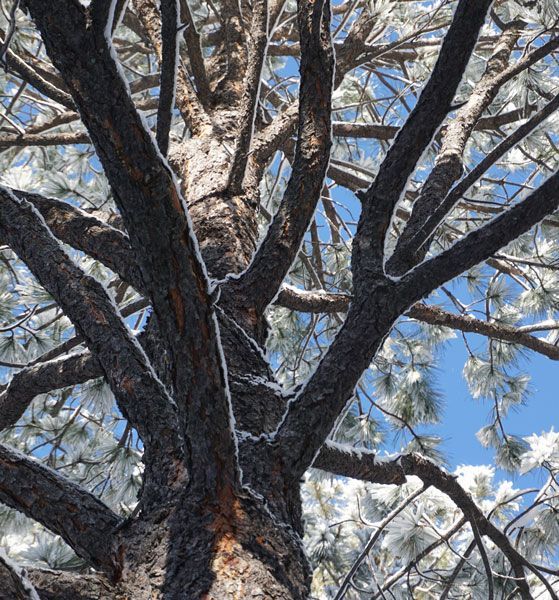
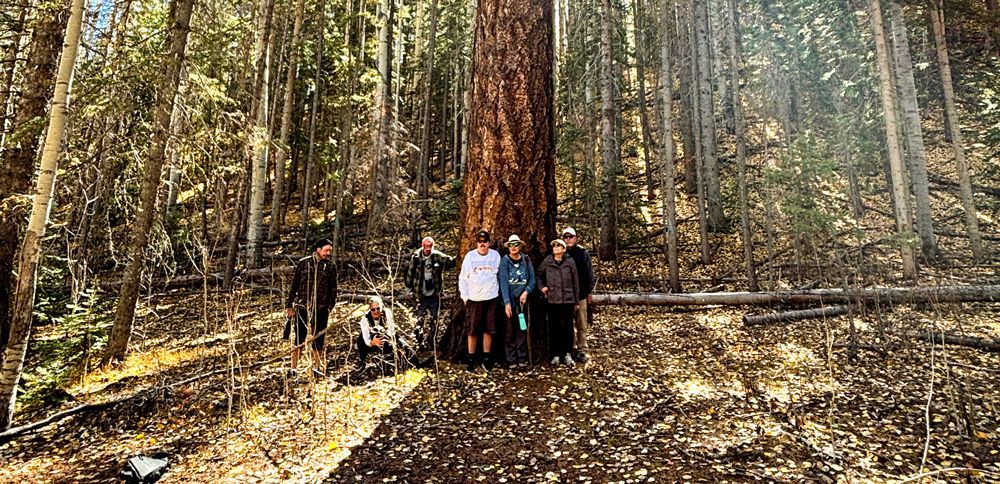
There is an ancient Douglas fir at the base of Green’s Peak. Its “craggy” bark is thick with age (nearly six inches thick), its base scarred and burned from a fire that took place over 130 years ago, and yet its crown reaches over 120 feet into the air. Sap flows down its east side, and there are large holes where an acorn woodpecker spent time digging for bugs — all signs of aging. All these signs show that this giant fir has spent centuries standing firm in this one spot — long enough that the surrounding trees, out of respect, it seems, keep their distance, giving it space. I am told it is the patriarchal tree, but I feel it is the mother tree.
The first time I saw the giant fir was in 2019. Tom Jernigan, a local author and avid cross-country skier, took a group of TRACKS members there. Jernigan’s book “Silent Witness” is all about the events throughout our White Mountains’ history that took place under the Coyote fir’s angular branches. The first few pages tell about the tree’s humble beginnings starting October 14, 1463. It reads, “In the midst of one large group of the slumbering giants is a small clearing in which a little young one can be seen, illuminated by the stars…Offspring of strong parents and favored by location, it is destined to become one of the largest and perhaps wisest of its kind.”
He calls it the stately little Coyote Fir. The name of a Zuni Native, Coyote, that kills a deer by the fir tree. His arrow is broken by the deer’s fall, “He picks the arrow up, turns and lays it across branches close to the trunk of a symmetrical little Douglas fir tree that stands near the center of the clearing.” Those of us who have read Jernigan’s book continue to reference it as the Coyote Fir. We sense its wisdom from times gone by and are fortunate to stand by one so grand. On the first day that we stood under its branches, it took 16 of us, shoulder to shoulder, to circle its entire base.
This year I went back to find the tree. Six years had passed, and I could not find it. Tom Jernigan drew me a map, but I put it in such a safe place that it was safe from me as well. Fortunately, the fall colors were pretty spectacular, so the hours we spent looking for the tree were well worth the adventure (see page24). When I got home, however, I pulled Jernigan’s book down from my shelf and found the map within its pages. I also got step-by-step directions texted to me from Carol Axford, based on her recent trip with Jernigan.
I discovered that just mentioning something about finding an ancient, giant tree gathers attention pretty quickly, and soon I had a group of eight friends ready to join my tree-finding adventure — and it was a perfect day for a hike. There was little wind, and the temperature was in the upper 60s.
The “stately Coyote Fir” stood tall in all of its majestic splendor, just as I had remembered. There is something magical about old, wise trees. Something you can sense as you rub your hand against its thick, rough bark. The Coyote fir has stood here for a very long time — standing the test of time. Just the thought of living for centuries is an incredible and mystical feat. Maybe if we listen closely, it could teach us its secrets of longevity, and yet, I say words of protection for this peaceful giant. Words to keep it from harm in a modern world that may not feel the same way I do about its ancestral worth.
I am not going to write the directions to the Coyote Fir in this article. However, if you would like to find it, go to the White Mountain Nature Center at 425 S. Woodland Road in Lakeside (see their ad on the back cover), and buy Tom Jernigan’s book. It’s a pretty short read and well worth it. I would recommend reading the book before you visit the tree. I will also put detailed directions on our website at www.outdoorssw.com/ visit our featured stories.
From Carol Axford
Take 260 past Sunrise then take Forest Rd 117 to the left. When you reach base of Green's Peak where 61 splits from 117, Stay on 117 to the right. Go quite a way then you will go down a hill, past a cattle guard. Watch for a road on the left, there are three large cattle drinking tubs( some blue) where you turn left. As you wind back you will see brown sign marker #8674. Also will see a clearing on left with tipi made of branches. Go to end for large parking area. Circle around facing back out. When you get out of car you will notice a path to the right heading down into the forest. Short walk in and Big tree is in a clearing. 500 yrs old and 120 ft tall. Large canopy of green top.